Lena Concierge: connecting bus stops and winter timetables
Lena connects bus-stop maps with winter timetable questions in Saas-Fee. What was prepared on 23 November 2026 and how it could help guests and hosts.
An AI concierge can help guests use local buses by connecting a stop, a travel date and the right timetable period. On 23 November 2026, Lena Concierge developed its winter timetable data and bus-stop map further. This article describes prepared development; public availability has not yet been confirmed.
At a glance: the map is intended to show where a stop is. A question tied to that stop should then lead the concierge to its departures. A stay before Christmas falls under a different timetable period from the main winter season.
Why a bus route name is only part of the answer
A guest wants to get from a holiday apartment in Saas-Fee to Alpin Express. “Take the village bus” leaves several practical questions unanswered: which stop should they use, which service calls there, and does it run on their travel date?
For someone staying in Saas-Grund or Saas-Almagell, the village matters too. A valley overview and a detailed village map serve different purposes. Guests need the map and the timetable question to refer to the same place.
This is a specific use for tourism AI: linking a selected place to a precise question. Useful guidance comes from that connection rather than a list of transport options alone.
What was prepared on 23 November
Organising winter information by period and stop
The revised information distinguishes winter 2026/27 from older seasonal entries. Alongside route overviews, information was prepared for individual stops: location, services calling there and departures in the underlying published timetable.
Timing within the season matters. The official Saas-Fee/Saas Valley village and ski bus page, checked on 27 November 2026, separates the preseason of 31 October–18 December 2026 from the winter season of 19 December 2026–18 April 2027. It links separate timetables for the two periods.
A route serving a stop in one period need not operate there in exactly the same way in the other. The prepared information therefore distinguishes preseason and main-season route assignments. “During winter” would be too broad.
From a map marker to a precise question
The prepared map includes a village view for Saas-Fee and a valley view with stops in Saas-Grund and Saas-Almagell. A selected stop has a card showing its name, village and services for both seasonal periods.
Two actions are provided: “Directions” opens a route to the stop; “Ask for departures” passes a question containing the stop name and village to the chat. Guests would not need to put those details together again themselves.
The stop card does not duplicate a departure table. Answers are intended to draw on the dedicated timetable data, avoiding a second set of departure times to maintain in the map.
Example: a stop map inside the chat
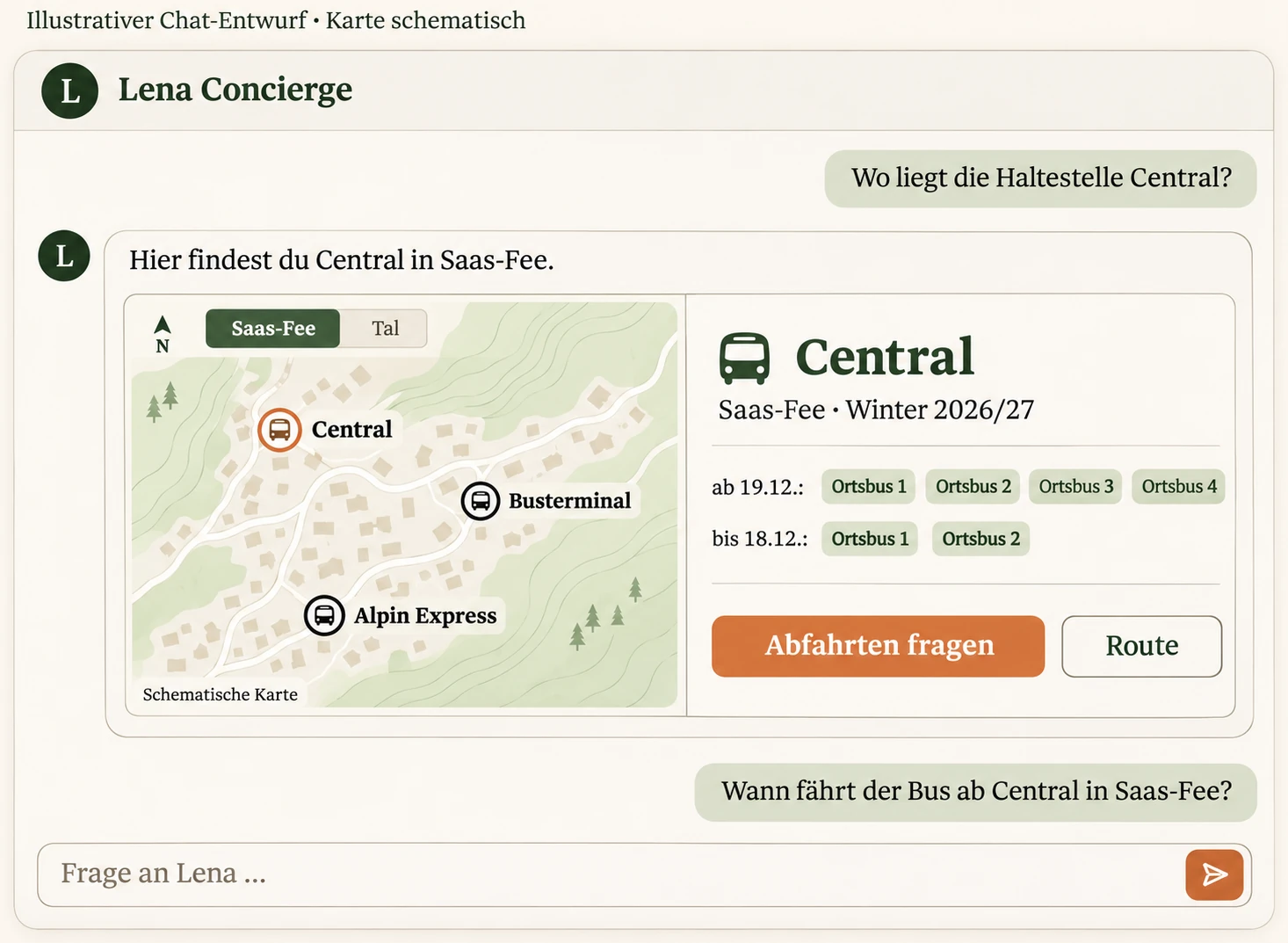
In the example, the guest first asks where Central is in Saas-Fee. The map connects the selected stop with its services. The departures action can turn that selection into a specific question about the same place.
How this could help a resort
Guests: finding the stop before asking about departures
A named stop on a map can help guests understand their surroundings. The follow-up question is more precise than “When does the bus leave?” That can be useful on arrival or in an unfamiliar part of the resort.
A map position alone confirms neither a departure nor uninterrupted service. The work described concerns stops and published timetables, not a verified live display of delays.
Hotels and holiday apartments: a clear starting point
Accommodation teams could point guests to a particular stop and explain its relationship to the village and travel date. This offers a possible service improvement on the journey from a property to a guest’s next destination. No measured time saving or reduction in enquiries has been established for these changes.
Destinations: putting published information in context
A destination publishes timetables; a guest usually asks about a particular journey. Connecting the two requires a stop name, position, route and validity period. Lena’s development illustrates how those details can be prepared as a coherent answer.
The Tourobs article on the Digital Transformation Canvas, published on 20 August 2026, considers benefits across the guest journey alongside organisational and data requirements. The source was checked on 27 November. Applied to a bus enquiry, the service begins with choosing the right stop.
Before announcing public availability, the full journey from map selection to an answer in the guest conversation needs confirmation. Linking further live operating information would be a separate step and is not presented here as complete.
For related context, read about Saas Valley events matched to travel dates and local Saas-Fee facts with source context.
The cover is a generated schematic illustration, not a navigation map or a photograph of the location.
Frequently asked questions
- Is the new bus-stop map publicly available?
- This article describes development prepared on 23 November 2026. Public availability has not yet been confirmed.
- Why does Lena distinguish preseason and main season?
- The official page publishes separate timetables for 31 October–18 December 2026 and 19 December 2026–18 April 2027. Services calling at a stop can differ.
- What is “Ask for departures” intended to do?
- It should send the concierge a question containing the stop name and village so the answer refers to that particular place.
- Does the map described show delays in real time?
- That capability has not been established by this development. The article describes stop information and published timetables.
- Where can I find the official bus timetables?
- On the official Saas-Fee/Saas Valley village and ski bus page linked in the article. Its timetables are organised by seasonal period.